Thursday, August 31, 2006

Monday, August 28, 2006
More Thoughts on Philip Rieff's "My Life Among the Deathworks"
I really see a lot of truth to his comments about for instance the creation of semblances but with the intent of destroying the actual, the real, and the essential nature of mendacity in this. I find it eerie and not merely reactionist how he descrbies modern times as therapeutic culture and therapeutic culture as being prefigured in Shakespeare's characters, Iago and Edmund. He describes Freud as a great founder of the moderna ge and analyzes his work as essentially a very intelligent, corrupting mendacity, a conscious fiction designed to attack the sacred in the belief that everything is just fiction anyway. I find him helpful in training the hand for cultural war, that is fighting before the firing starts, defending that worthy of defense, first by recognizing the intent deathwork of enemies of sacred order (I see his stance for sacred order as having a real compatibility with mine). I do not think it pleasing or inevitable to float away on the dream reality of a more or less conscious lie and I think it is a healthy development to call it lieing with the strength that Rieff does. His stance for the sacred which Sontag seems to have repudiated in her divorce of him and subsequent comments seems to me the more worthy one.
Thursday, August 24, 2006
Article on Philip Rieff
``How dare we dismiss the authority of the past as if we understood it?" Philip Rieff wrote in 1973.
"Rieff's aphorisms - their eloquent crankiness- have a way of getting under your skin. ``A culture in which everything can be said and shown," he wrote in 1968, ``will produce, as night follows day, a society in which everything, no matter how terrible, can be done."
That sentence might well have appeared in ``Regarding the Torture of Others," Sontag's commentary on the Abu Ghraib photographs. And in 1996, looking back on her first collection of essays, including the one denouncing ``piety without content," she sounded this Rieffian note: ``The time we live in is experienced as the end-more exactly, just past the end-of every ideal....The undermining of standards of seriousness is almost complete.""
-Article
"Rieff's aphorisms - their eloquent crankiness- have a way of getting under your skin. ``A culture in which everything can be said and shown," he wrote in 1968, ``will produce, as night follows day, a society in which everything, no matter how terrible, can be done."
That sentence might well have appeared in ``Regarding the Torture of Others," Sontag's commentary on the Abu Ghraib photographs. And in 1996, looking back on her first collection of essays, including the one denouncing ``piety without content," she sounded this Rieffian note: ``The time we live in is experienced as the end-more exactly, just past the end-of every ideal....The undermining of standards of seriousness is almost complete.""
-Article
Monday, August 21, 2006
Recognizing that Nature is a Work of Genius Encourages Science Rather than Stopping It
A Meaningful World: How the Arts and Sciences Reveal the Genius of Nature : "Moreover, the careful study of works of genius encourages investigative optimism- the conviction, born of experience, that many inscrutable things in a work of genius are only apparently so and, that, with sustained effort, the work will yield up more and more of its secrets, giving us a clearer eye and a more comprehensive viewpoint. In sum, the scientist who recognizes nature as a work of genius can explain- rather than merely explain away- our collective experience of repeatedly uncovering new mysteries and or repeatedly uncovering answers to those mysteries." p. 28
Jane Austen Describes an Early Animal Liberationist?
"To the education of her daughters Lady Bertram paid not the smallest attention. She had not time for such cares. She was a woman who spent her days in sitting, nicely dressed, on a sofa, doing some long piece of needlework, of little use and no beauty, thinking more of her pug than her children, but very indulgent to the latter when it did not put herself to inconvenience, guided in everything important by Sir Thomas, and in smaller concerns by her sister. Had she possessed greater leisure for the service of her girls, she would probably have supposed it unnecessary, for they were under the care of a governess, with proper masters, and could want nothing more. "
-Mansfield Park, Capter 2, p. 17 (ital. added)
-Mansfield Park, Capter 2, p. 17 (ital. added)
Sunday, August 20, 2006
The Existence of the Soul and the Assumption of Human Freedom of Choice
I liked the following argument I made in an online discussion about the existence of the soul and whether atheists can be moral or not:
Let me make several points here which however hard they may be to take are true (and if you have not thought them out Doestoevsky and Nietzsche have). First, it makes no sense for a person to speak of morality who is a determinist. Apart from any consideration of whether the determinist position is correct or not, speaking of what a person ought or ought not to do is clearly meaningless because the person is propelled by outside forces and is not capable of making a decision according to the determinist position. Therefore it is a species of mendacity to protest that a determinist atheist may be moral too, from a determinist atheist point of view, because there are no categories of morality in determinism. Fate neither affirms nor denies moral behavior. Morality belongs to a civilization that believes in human freedom of choice. There is clearly no sense in claiming for determinists that they are moral people too since their very worldview repudiates notions of morality. Therefore it is deceptive mendacity to say that they are moral except if one is operating with the assumption of human freedom, and should a determinst argue this why should it not be supposed that they may also be lieing in the supression of the recognition of the authentic categories of moral perception in their core beliefs as well since they lie about their affiliation with systems of morality? But this is entirely about the deterministic atheist. It is true to say that not every atheist believes in determinism. Even Epicurus (not entirely an atheist though) introduced a mystical swerve into his account of the nature of atom's freefall to account for human freewill. But the question is, if we are not determined by outside physical causality, if we have real choice and therefore real moral categories, how do we account for these in a purely materialist worldview? To say here that materialists, etc. can be moral people is beside the point. The question is if their worldview accounts for their moral categories, if they have a comprehensible synthesis of human experience, or if they are really foolish and self contradictory as Bernanos charges. In what mysterious way can we hold to human freedom of choice and not circumscribe natural inferences from its essential independence to the ontological reality of the soul? If humans are able to choose morally then they are free. If they are free, then it seems they are independent in a significant sense from material casality at the point of their choice- they are not driven by material causality in their moral descision-making. If they are independent from material causality in such a significant, civilization forming way, then it is plausible that they have souls, that element that governs their bodies that are otherwise driven by material causality.
Let me make several points here which however hard they may be to take are true (and if you have not thought them out Doestoevsky and Nietzsche have). First, it makes no sense for a person to speak of morality who is a determinist. Apart from any consideration of whether the determinist position is correct or not, speaking of what a person ought or ought not to do is clearly meaningless because the person is propelled by outside forces and is not capable of making a decision according to the determinist position. Therefore it is a species of mendacity to protest that a determinist atheist may be moral too, from a determinist atheist point of view, because there are no categories of morality in determinism. Fate neither affirms nor denies moral behavior. Morality belongs to a civilization that believes in human freedom of choice. There is clearly no sense in claiming for determinists that they are moral people too since their very worldview repudiates notions of morality. Therefore it is deceptive mendacity to say that they are moral except if one is operating with the assumption of human freedom, and should a determinst argue this why should it not be supposed that they may also be lieing in the supression of the recognition of the authentic categories of moral perception in their core beliefs as well since they lie about their affiliation with systems of morality? But this is entirely about the deterministic atheist. It is true to say that not every atheist believes in determinism. Even Epicurus (not entirely an atheist though) introduced a mystical swerve into his account of the nature of atom's freefall to account for human freewill. But the question is, if we are not determined by outside physical causality, if we have real choice and therefore real moral categories, how do we account for these in a purely materialist worldview? To say here that materialists, etc. can be moral people is beside the point. The question is if their worldview accounts for their moral categories, if they have a comprehensible synthesis of human experience, or if they are really foolish and self contradictory as Bernanos charges. In what mysterious way can we hold to human freedom of choice and not circumscribe natural inferences from its essential independence to the ontological reality of the soul? If humans are able to choose morally then they are free. If they are free, then it seems they are independent in a significant sense from material casality at the point of their choice- they are not driven by material causality in their moral descision-making. If they are independent from material causality in such a significant, civilization forming way, then it is plausible that they have souls, that element that governs their bodies that are otherwise driven by material causality.
Brennan Manning on Compassion and Human Dignity
Brennan Manning in Abba’s Child:
“Homophobia and racism are among the most serious and vexing issues of this generation, and both church and society seem to limit us to polarized options.
The anything-goes morality of the religious and political Left is matched by the sanctimonious moralism of the religious and political Right. Uncritical acceptance of any party line is an idolatrous abdication of one’s core identity as Abba’s child. Neither liberal fairy dust nor conservative hardball addresses human dignity, which is often dressed in rags.” P.75
“The heartfelt compassion that hastens forgiveness matures when we discover where our enemy cries.” P.69
“Homophobia and racism are among the most serious and vexing issues of this generation, and both church and society seem to limit us to polarized options.
The anything-goes morality of the religious and political Left is matched by the sanctimonious moralism of the religious and political Right. Uncritical acceptance of any party line is an idolatrous abdication of one’s core identity as Abba’s child. Neither liberal fairy dust nor conservative hardball addresses human dignity, which is often dressed in rags.” P.75
“The heartfelt compassion that hastens forgiveness matures when we discover where our enemy cries.” P.69
Saturday, August 19, 2006
Georges Bernanos
My soul is stunned, and delighted, and faintly feels the healing touch of a pure joy encountering the work of Georges Bernanos for the first time, having just finished the short novel Mouchette.
Here is a rich wealth of insight.
"Wisdom has built her house,
she has set up her seven columns.
She has dressed her meat, mixed her wine,
yes, she has spread her table." Proverbs 9:1-2
She has indeed- in such writings as Bernanos's, and elsewhere. Here are some quotes from Bernanos's later essays:
Excerpts from The Last Essays of Georges Bernanos, translated by Joan and Barry Ulanov (Chicago, Henry Regnery Company, 1955) (culled from a larger list of quotes compiled at the following location place: http://leowong2004.blogspot.com/2005/08/bernanos-last-essays.html)
"It’s a question of knowing who will win, technology or man."
"The millions don’t care a bit about learning that we don’t despair of ourselves. What they want to know is if they can place their hope in us. They care nothing about our optimism. Our optimism does not reassure them at all. Quite the opposite, it sends a shiver down their spines."
"I realize that anyone who refuses to be deceived today must someday or other pursue his path all alone, as I have been doing for a long time. I’m used to it now. I even think that a little solitude is not too high a price to pay for certain modest privileges which no one dreams of trying to take away from me, such as the right to speak the way I do—with a tranquil frankness—in my own name alone."
"Speculation commanded machines, and thanks to machines commanded power as well. Thus, in a fabulously short time, by the single miracle of technology and of all techniques, including that which not only allows the control of worldwide opinion but also the making of it, it has created a civilization in the image of a prodigiously diminished and shrunken man, a man no longer made in the image of God, but in the image of the speculator—that is to say, of a man reduced to the two states, both equally miserable, of consumer and taxpayer ".
"It is necessary above all to re-spiritualize man. . . . It is right to put these ideas back into circulation, as formerly people took old coins and melted them down [LW: not repackaged] into gold and silver again "
"Hope is a heroic virtue. People think it easy to hope. But the only people who hope are those who have had the courage to despair of illusions and lies in which they had once found a security they falsely took for hope."
"But what if man really was created in the image of God? Suppose there is in him a certain element of freedom—however small one may imagine it—to what would their experiments lead then, if not to the mutilation of an essential organ? What if in man there does exist that principle of self-destruction, that mysterious hatred of himself which we call original sin, which the technologists have not failed to observe, for it explains all the frightful disappointments of history? It’s true that they don’t attribute these disappointments to man’s sin but rather to an evil organization of the world. But what if they are mistaken? What if the injustice is inside man himself and all their constraints do nothing but reinforce the evil-doing? What if man can only fulfill himself in God? What if the delicate operation of amputating his divine part—or of systematically making this part atrophy until it falls off, dried up, like an organ in which blood no longer circulates—should turn him into a ferocious beast? Or worse, perhaps, a beast forever domesticated, a domestic animal? Or, even worse, something abnormal, deranged? "
One understands nothing of man if one imagines him to be naturally proud of what distinguishes him, or seems to distinguish him, from animals. The average man is not at all proud of his soul; he wants only to deny it and does so with great relief, as upon awaking from a terrible dream. He thinks, with a kind of incomprehensible pride, that he has just discovered that it really doesn’t exist. Metaphysical anxiety in the average man is almost always shown by this sly denial, this pride, the thousand tricks which only tend to lay aside some part, it doesn’t matter which, of this burden, this harassing consciousness of good and evil. . . . If only that soul didn’t exist! If it does by some mischance exist, if only it were not immortal! Very far from being the consoling illusion of the simple-minded and the unknowing, belief in liberty and in the responsibility of man has been for thousands of years the tradition of the élite; it is the spirit of civilization, civilization itself, transmitted through genius. For ages, billions of fools, fools without number, in languages without number, have said again and again, with a knowing look, “When you’re dead, you’re dead.” If they haven’t said these exact words, it was because they didn’t dare, because they were ashamed to say them; they preferred to trust in those more learned than they, the wise ones. But as soon as the prestige of the wise and the authority weaken, as soon as civilization gives way, the men of the masses begin again to look for a vacant lot, a street corner, on which to lose their immortal souls, with the hope that no one will bring them back to them. And suddenly now, in our time, this gesture held to be ignoble, until now, has been adopted by the wise men too. Those one always thought of as guardians of the highest traditions of the species have refused to keep it in their charge (ibid.).There is something more in man than those deceivers think who believe him inspired only by self-interest. There is in man a secret and incomprehensible hatred, not only of his fellow men but of himself. One may cite for this mysterious feeling any cause or explanation one wishes, but one must explain it. As for us Christians, we believe this hatred reflects another hatred a thousand times deeper and more clear—that of the Unspeakable Spirit who was the most resplendent of the stars of the abyss, who will never forgive us for his terrible fall. Apart from the assumption of original sin, that is to say of a basic contradiction in our nature, the concept of man becomes clear, but it is no longer man. Man has passed byeond the definition of man, just like a handful of sand between his fingers (ibid.).. . . a world without a god . . . will soon be a world without men. Thus, it makes more glorious still the mysterious solidarity of God and man which is the most august mystery of Christianity (ibid.)."
"I blush at the idea that [a non-Catholic] may think I address him from the depths of my security as a believer—as from a safe and warm resting place—that I hold myself apart from the risks he runs. It isn’t true, no, it isn’t true, that faith is security, at least in the human inflection of the word."
"The scandal of the universe isn’t suffering but freedom. God made His Creation free—that’s the scandal of scandals, for all others proceed from it."
"Right now, in our world, in some obscure church or some old house or at the bend of a deserted road, there is some poor man who is joining his hands and from the depths of his misery, without really knowing what he is saying, or perhaps without saying anything at all, is thanking the good Lord for having made him free and capable of loving. Elsewhere, it doesn’t matter where, there is a mother who is hiding her face for the last time against the little heart that no longer throbs, a mother, close to her dead child, offering God the moaning of an exhausted resignation, as if the Voice that threw the suns into the great void the way a hand disperses grain, the Voice that makes the earth tremble, had just sweetly whispered in her ear: “Forgive Me. One day you will know, you will understand, you will thank Me. But now, what I await from you is your pardon. Forgive Me.” Those people—the harassed women, that poor man—are at the heart of the mystery, at the core of the universal creation and even inside the secret of God Himself. What can I say of this? Language is at the service of intelligence. But what these people have grasped, they have understood by a faculty superior to the intelligence, though not at all in conflict with it, or rather by a profound and irresistable impulse of the soul which engages all the faculties at the same time, which thoroughly absorbs all that is natural in them. . . . "
"In his recent book, Les problèmes de la vie, the distinguished University of Geneva professor, M. Guyénot, has gone back to the distinction between body, mind, soul. If one accepts this hypothesis, which Saint Thomas did not reject, one tells oneself, with horror, that innumerable men are born, live and die without even once making use of their souls, really making use of their souls, even if only to offend the good Lord. To what extent are we not of the same species? Won’t Damnation be the tardy discovery, the discovery much too late, after death, of a soul absolutely unused, still carefully folded together, and spoiled, the way certain precious silks are when they are not used? Anyone who makes use of his soul, however clumsily, participates in the life of the universe, becomes a part of its great rhythm, and at the same time enters on a level with the saints that communion of the saints that which is the communion of all the men of good will to whom Peace was promised, that Holy Invisible Church which we know includes pagans, heretics, schismatics or non-believers, whose name God alone knows (ibid.)."
"For, after all, it is as easy for us to recognize what the Church has of the human in her as it is difficult to know what she has in her of the divine. How else then would you explain the oddity that those most entitled to be scandalized by the mistakes, the deformations, or even the deformaties, of the visible Church—I mean the saints—are precisely those how never complain about her?"
"The saint is the person who knows how to find in himself, and to make gush forth from the depths of his being, the water of which Christ spoke to the Samaritan woman: “Those who drink of it will never thirst.” The water is there in each of us, the deep cistern open under the sky. Undoubtedly the surface is cluttered with debris, broken branches, dead leaves, from which arises the smell of death. On it shines a cold and hard light, that of the rational intelligence. But immediately under that pernicious layer, the water is so limpid and pure! Still a little lower, and the soul finds herself again in her native element, infinitely purer than the purest water, in that uncreate light that bathes all Creation—in Him was life, and the life was the light of men—in ipso vita erat et vita erat lux hominum (ibid.)."
"For there is something which is worse than dying—it is to die deceived."
Here is a rich wealth of insight.
"Wisdom has built her house,
she has set up her seven columns.
She has dressed her meat, mixed her wine,
yes, she has spread her table." Proverbs 9:1-2
She has indeed- in such writings as Bernanos's, and elsewhere. Here are some quotes from Bernanos's later essays:
Excerpts from The Last Essays of Georges Bernanos, translated by Joan and Barry Ulanov (Chicago, Henry Regnery Company, 1955) (culled from a larger list of quotes compiled at the following location place: http://leowong2004.blogspot.com/2005/08/bernanos-last-essays.html)
"It’s a question of knowing who will win, technology or man."
"The millions don’t care a bit about learning that we don’t despair of ourselves. What they want to know is if they can place their hope in us. They care nothing about our optimism. Our optimism does not reassure them at all. Quite the opposite, it sends a shiver down their spines."
"I realize that anyone who refuses to be deceived today must someday or other pursue his path all alone, as I have been doing for a long time. I’m used to it now. I even think that a little solitude is not too high a price to pay for certain modest privileges which no one dreams of trying to take away from me, such as the right to speak the way I do—with a tranquil frankness—in my own name alone."
"Speculation commanded machines, and thanks to machines commanded power as well. Thus, in a fabulously short time, by the single miracle of technology and of all techniques, including that which not only allows the control of worldwide opinion but also the making of it, it has created a civilization in the image of a prodigiously diminished and shrunken man, a man no longer made in the image of God, but in the image of the speculator—that is to say, of a man reduced to the two states, both equally miserable, of consumer and taxpayer ".
"It is necessary above all to re-spiritualize man. . . . It is right to put these ideas back into circulation, as formerly people took old coins and melted them down [LW: not repackaged] into gold and silver again "
"Hope is a heroic virtue. People think it easy to hope. But the only people who hope are those who have had the courage to despair of illusions and lies in which they had once found a security they falsely took for hope."
"But what if man really was created in the image of God? Suppose there is in him a certain element of freedom—however small one may imagine it—to what would their experiments lead then, if not to the mutilation of an essential organ? What if in man there does exist that principle of self-destruction, that mysterious hatred of himself which we call original sin, which the technologists have not failed to observe, for it explains all the frightful disappointments of history? It’s true that they don’t attribute these disappointments to man’s sin but rather to an evil organization of the world. But what if they are mistaken? What if the injustice is inside man himself and all their constraints do nothing but reinforce the evil-doing? What if man can only fulfill himself in God? What if the delicate operation of amputating his divine part—or of systematically making this part atrophy until it falls off, dried up, like an organ in which blood no longer circulates—should turn him into a ferocious beast? Or worse, perhaps, a beast forever domesticated, a domestic animal? Or, even worse, something abnormal, deranged? "
One understands nothing of man if one imagines him to be naturally proud of what distinguishes him, or seems to distinguish him, from animals. The average man is not at all proud of his soul; he wants only to deny it and does so with great relief, as upon awaking from a terrible dream. He thinks, with a kind of incomprehensible pride, that he has just discovered that it really doesn’t exist. Metaphysical anxiety in the average man is almost always shown by this sly denial, this pride, the thousand tricks which only tend to lay aside some part, it doesn’t matter which, of this burden, this harassing consciousness of good and evil. . . . If only that soul didn’t exist! If it does by some mischance exist, if only it were not immortal! Very far from being the consoling illusion of the simple-minded and the unknowing, belief in liberty and in the responsibility of man has been for thousands of years the tradition of the élite; it is the spirit of civilization, civilization itself, transmitted through genius. For ages, billions of fools, fools without number, in languages without number, have said again and again, with a knowing look, “When you’re dead, you’re dead.” If they haven’t said these exact words, it was because they didn’t dare, because they were ashamed to say them; they preferred to trust in those more learned than they, the wise ones. But as soon as the prestige of the wise and the authority weaken, as soon as civilization gives way, the men of the masses begin again to look for a vacant lot, a street corner, on which to lose their immortal souls, with the hope that no one will bring them back to them. And suddenly now, in our time, this gesture held to be ignoble, until now, has been adopted by the wise men too. Those one always thought of as guardians of the highest traditions of the species have refused to keep it in their charge (ibid.).There is something more in man than those deceivers think who believe him inspired only by self-interest. There is in man a secret and incomprehensible hatred, not only of his fellow men but of himself. One may cite for this mysterious feeling any cause or explanation one wishes, but one must explain it. As for us Christians, we believe this hatred reflects another hatred a thousand times deeper and more clear—that of the Unspeakable Spirit who was the most resplendent of the stars of the abyss, who will never forgive us for his terrible fall. Apart from the assumption of original sin, that is to say of a basic contradiction in our nature, the concept of man becomes clear, but it is no longer man. Man has passed byeond the definition of man, just like a handful of sand between his fingers (ibid.).. . . a world without a god . . . will soon be a world without men. Thus, it makes more glorious still the mysterious solidarity of God and man which is the most august mystery of Christianity (ibid.)."
"I blush at the idea that [a non-Catholic] may think I address him from the depths of my security as a believer—as from a safe and warm resting place—that I hold myself apart from the risks he runs. It isn’t true, no, it isn’t true, that faith is security, at least in the human inflection of the word."
"The scandal of the universe isn’t suffering but freedom. God made His Creation free—that’s the scandal of scandals, for all others proceed from it."
"Right now, in our world, in some obscure church or some old house or at the bend of a deserted road, there is some poor man who is joining his hands and from the depths of his misery, without really knowing what he is saying, or perhaps without saying anything at all, is thanking the good Lord for having made him free and capable of loving. Elsewhere, it doesn’t matter where, there is a mother who is hiding her face for the last time against the little heart that no longer throbs, a mother, close to her dead child, offering God the moaning of an exhausted resignation, as if the Voice that threw the suns into the great void the way a hand disperses grain, the Voice that makes the earth tremble, had just sweetly whispered in her ear: “Forgive Me. One day you will know, you will understand, you will thank Me. But now, what I await from you is your pardon. Forgive Me.” Those people—the harassed women, that poor man—are at the heart of the mystery, at the core of the universal creation and even inside the secret of God Himself. What can I say of this? Language is at the service of intelligence. But what these people have grasped, they have understood by a faculty superior to the intelligence, though not at all in conflict with it, or rather by a profound and irresistable impulse of the soul which engages all the faculties at the same time, which thoroughly absorbs all that is natural in them. . . . "
"In his recent book, Les problèmes de la vie, the distinguished University of Geneva professor, M. Guyénot, has gone back to the distinction between body, mind, soul. If one accepts this hypothesis, which Saint Thomas did not reject, one tells oneself, with horror, that innumerable men are born, live and die without even once making use of their souls, really making use of their souls, even if only to offend the good Lord. To what extent are we not of the same species? Won’t Damnation be the tardy discovery, the discovery much too late, after death, of a soul absolutely unused, still carefully folded together, and spoiled, the way certain precious silks are when they are not used? Anyone who makes use of his soul, however clumsily, participates in the life of the universe, becomes a part of its great rhythm, and at the same time enters on a level with the saints that communion of the saints that which is the communion of all the men of good will to whom Peace was promised, that Holy Invisible Church which we know includes pagans, heretics, schismatics or non-believers, whose name God alone knows (ibid.)."
"For, after all, it is as easy for us to recognize what the Church has of the human in her as it is difficult to know what she has in her of the divine. How else then would you explain the oddity that those most entitled to be scandalized by the mistakes, the deformations, or even the deformaties, of the visible Church—I mean the saints—are precisely those how never complain about her?"
"The saint is the person who knows how to find in himself, and to make gush forth from the depths of his being, the water of which Christ spoke to the Samaritan woman: “Those who drink of it will never thirst.” The water is there in each of us, the deep cistern open under the sky. Undoubtedly the surface is cluttered with debris, broken branches, dead leaves, from which arises the smell of death. On it shines a cold and hard light, that of the rational intelligence. But immediately under that pernicious layer, the water is so limpid and pure! Still a little lower, and the soul finds herself again in her native element, infinitely purer than the purest water, in that uncreate light that bathes all Creation—in Him was life, and the life was the light of men—in ipso vita erat et vita erat lux hominum (ibid.)."
"For there is something which is worse than dying—it is to die deceived."
Thursday, August 17, 2006
Sins Concatenated on Sins: The Film Documentary "Capturing the Friedman's"
I just watched the film documentary "Capturing the Friedman's" with some friends and I want to record here some of my impressions. The mother struck me as the most sensible and morally acute of this deeply sorrowed family. She seems to have done her son Jesse a true service, to have guided him wisely despite the other two brothers being estranged from her. It was Jesse who went to jail, as did his father, for child molestation, and I wonder if he does not sense that she defended him best in the situation and that his brothers are both in denial in rejecting their mother. The charges brought against them both seem clearly inflated in an atmosphere of hysteria but the father professed in private to having molested his brother over a period of two years and having fed a lifelong pedafilia. Why am I even thinking about this movie or trying to come to a judgement on them? But there is something to be drawn from this movie. Clearly the father was a pedafile- no one denied that. But the hysterical reactions of the investigators and society seemed to have created a fog of justice. Justice is attacked from all sides. The terrible sorrow Mr. Friedman brought on himself and his family is, however, clear. The reactions, though apparently disproportionate, were reactions to something he had set in motion over a very long period of time.
There is a film clip of his sister as a little girl performing pirouettes, played several times in the movie. A beautiful moment of innocence and beauty. She died young from bloodpoisoning and it tore her family apart. The pain, and the perversion.
Mr. Friedman stated that he molested his younger brother over a period of two years. Apparently this is where it began for him. The younger brother, a man of 65 years of age, living together with another man in a homosexual relationship, can not remember any molestation. The confusion over a long evil seems to persist. The pain Mr. Friedman suffered could have been dealt with in a healing way. I dismiss the mendacious genetic determinists from the room. We are human and as human we have a choice and a responsibility to chose the right. He repeatedly chose the wrong. I too have repeated sins in my life. Let the folly, the sorrow and pain of others be a lesson to all of us who struggle with persistent sin. The mother has sought to heal and has seemingly made the most progress in the family.
I am reminded of a sermon by John Donne in which he urges the confession of sin immediately upon my or your first awareness of it, lest sin concatenate on sin. Our private sins may cause more untold misery than we now imagine. Lord, to be clean and clear of every sin, confessing everyone at its inception!
There is a film clip of his sister as a little girl performing pirouettes, played several times in the movie. A beautiful moment of innocence and beauty. She died young from bloodpoisoning and it tore her family apart. The pain, and the perversion.
Mr. Friedman stated that he molested his younger brother over a period of two years. Apparently this is where it began for him. The younger brother, a man of 65 years of age, living together with another man in a homosexual relationship, can not remember any molestation. The confusion over a long evil seems to persist. The pain Mr. Friedman suffered could have been dealt with in a healing way. I dismiss the mendacious genetic determinists from the room. We are human and as human we have a choice and a responsibility to chose the right. He repeatedly chose the wrong. I too have repeated sins in my life. Let the folly, the sorrow and pain of others be a lesson to all of us who struggle with persistent sin. The mother has sought to heal and has seemingly made the most progress in the family.
I am reminded of a sermon by John Donne in which he urges the confession of sin immediately upon my or your first awareness of it, lest sin concatenate on sin. Our private sins may cause more untold misery than we now imagine. Lord, to be clean and clear of every sin, confessing everyone at its inception!
Wednesday, August 16, 2006
Napoleon in Rags: "Wonderful Fool" by Shusaku Endo
I just finished Wonderful Fool by Shusaku Endo, the fifth novel I have read by him. Like the others, this one was outstanding. He wrote very skillfully and deeply perceptively about human nature. Endo always chooses topics, it seems, which are uncomfortable, which draw up against the reader's "flesh" or that part of them that is worldly and selfish at the expense of others' wellbeing. (As a Japanese too he chooses topics which are particularly unflattering for the Japanese people like the crucifixtions of Portugese missionaries in Silence, the experimentation on POWs in The Sea and Poison, and the pornography industry and sex trade in Scandal. In Wonderful Fool his readers see some of the gangs, spend time with the prostitutes, and go around the slums of Tokyo with a hitman, but all as seen from a holy heart of love, it seems clear to me. Endo is not content to remain on the surface of things- his art is nobler than that and his love more burning than that. He brings his reader with him to touch the nerves that run so deep they cross beyond his cultural moment to the universal heart of mankind.
His characters always act from weakness and sorrow and struggle and failure. Gaston, the socially inept, the ugly, the slow-minded, reaching out to Japan with the most powerful thing in the world, love, but covered in a ball of rags.
Like Scandal this novel contained characters deeply effected by warcrimes that those close to them had participated in. The hitman Endo (Endo likes to make the criminal characters reflect identity with him in some way in some of his novels, naming the hitman Endo or making the main character of Scandal a Christian writer, like Endo, of a Life of Christ.) turns to a life of hatred and coldblooded murder when faced with his brother's having carried out orders to burn the occupants of a village and the brother's subsequent framing by his commanding officers. Gaston persistantly, doggedly, beyond all civil tepid-ity, urges Endo from a position of weakness not to go through with his plot of revenge on the officers. Gaston, despite his outer weakness and failure, is a real man, as the character Takamori discerns, because he takes a stand for the right thing despite his weaknesses that he could have so easily taken as excuses not to do what he should. It is integrity to the gospel that Endo has witnessed, bears witness to, keeps within himself. The "fool" is wonderful for this integrity, this sacred obedience, this longsuffering love, which endures blows and persecutions by the ones he is trieing to help, and which has takes the courage to recognize that he can and must help, that he must, despite all his weakness and absurdity in the eyes of the world, come to Japan for love. Hallelujah!
Endo ends by tieing Gaston's mysterious end into the early Japanese story, "The Tale of the Bamboo Cutter." Gaston is a descendant of Napoleon and a stark contrast to the prideful dictator.
His characters always act from weakness and sorrow and struggle and failure. Gaston, the socially inept, the ugly, the slow-minded, reaching out to Japan with the most powerful thing in the world, love, but covered in a ball of rags.
Like Scandal this novel contained characters deeply effected by warcrimes that those close to them had participated in. The hitman Endo (Endo likes to make the criminal characters reflect identity with him in some way in some of his novels, naming the hitman Endo or making the main character of Scandal a Christian writer, like Endo, of a Life of Christ.) turns to a life of hatred and coldblooded murder when faced with his brother's having carried out orders to burn the occupants of a village and the brother's subsequent framing by his commanding officers. Gaston persistantly, doggedly, beyond all civil tepid-ity, urges Endo from a position of weakness not to go through with his plot of revenge on the officers. Gaston, despite his outer weakness and failure, is a real man, as the character Takamori discerns, because he takes a stand for the right thing despite his weaknesses that he could have so easily taken as excuses not to do what he should. It is integrity to the gospel that Endo has witnessed, bears witness to, keeps within himself. The "fool" is wonderful for this integrity, this sacred obedience, this longsuffering love, which endures blows and persecutions by the ones he is trieing to help, and which has takes the courage to recognize that he can and must help, that he must, despite all his weakness and absurdity in the eyes of the world, come to Japan for love. Hallelujah!
Endo ends by tieing Gaston's mysterious end into the early Japanese story, "The Tale of the Bamboo Cutter." Gaston is a descendant of Napoleon and a stark contrast to the prideful dictator.
Sunday, August 06, 2006
"Methodological Materialism" is a Partisan Definition of Science
I debated with several at arn.org/boards the distinction between science and materialism and liked some of what I wrote. Here is the link to the discussion thread.
Here are key excerpts from my remarks:
It seems to me that if we assume that science is quintessentially materialism, we should expect that materialism would produce the best scientists. In fact is this what we find? How many fullblown materialist scientists (a full blown materialist being someone like Daniel Dennett and Richard Dawkins) are among the best scientists in history? ...
Let me quote here again Eric Voegelin describing the nature of materialism:
As Voegelin points out correctly, it seems to me, the main purpose of materialism is not an inquiry into nature. It is rather an emotional reaction to pain and suffering in the world, one psychological option for coping with the emotional stresses that exist. Do people who adopt such a worldview, which appears to me emotionally off kilter, produce the best scientists or are they rather primarily rockstar celebrities like Bertrand Russell and Richard Dawkins with a little science and a lot of philosophy?In one sense it is clear there is no particular worldview required to merely investigate material causalities. It takes assiduity and a certain orderly discipline, etc. But for the real geniuses, I wonder how many we can find that were willing to stand the rigid boundaries of materialism and keep their fertile thought cupped inside it...
Theism corresponds most precisely with reality when it is clarified properly. It has the innate potential for such clarification. But Materialism does not correspond precisely with reality which is why I evince such doubt about it's being good for science in the long run for so many people today to be conflating science with Materialism. It is a pseudo scientific development from my perspective and pseudo science whether Materialist or creationist is just as bad in my opinion for science....
Theism is more accurate because it takes better account of the observer. As many wise scientists have remarked we should not hold the two aspects of existence apart and think that we can reach the answer to everything by ommitting one. Even Feynman I believe said this. A clarified theism would be one which would eschew the gnostic despising of the world suggested by certain readings of Plato and so would avoid both the extreme of materialism and the extreme of a view that despises the physical existence. Theism can hold these two together, and indeed in Christ they are perfectly united. Materialists are unable to understand by constriction of their doctrine that Socrates was hitting upon reality, or indeed most of the wiser literary giants. They are devoted to a system that inures them to Socrates' goads to self-examination. Even the fairy tales are hitting upon reality. This is something that escapes materialsts because they have become servile to a method and are not first being men and women in correspondence with truth proper...
Modern materialists have allowed their infatuated attachment to the methodology of the natural sciences to cripple them to basic understandings of the world beyond this and so by trieing to make one aspect of man's theoretical synthesizing nature carry all are distorting and destroying the synthesizing nature of man altogether. It seems to me that materialism ultimately results in the undermining of science. It is supposed that whatever exists is the result of random processes and selection as a result of randomness. Then the assumption seems naturally to follow that the order which our minds percieve in the natural world is essentially a construct and that if we are true to the nature of reality as our faith in naturalism tells us it is, then we ultimately, with enough application of the logic of our theory must deconstruct all perception of order into a chaos of randomness. Laws that result from randomness are not truly laws. How can they be? If the laws came before and bounded the randomness than the question obviously arises where the laws came from. Teleological answers are the best answers here. Because teleological answers relieve us of the burden of resolving everything into randomness we are enabled to gain a dynamic confidence about the order we percieve and a proper confidence in their reliable nature...
...the notion expressed by Democritus (and Sagan) that the universe is all there is, all there was, and all there ever will be. Again there is too much extraneous content in just this doctrine alone. The suggestion that scientists are engaging in materialism is a poetic comparison of two very different things , a worldview and a method. Whereas the method of focusing on material causality in order to learn about the order witnessed in nature is harmonious with theism and is a true common ground, the worldview of materialism emotionally aims at excluding belief in God by any means, whether by reason or rationalization (see Gilson's comments in the previous post about Epicurus, and Darwin's thought on Lamarck). As the reoccurence of materialism with the other doctrines is seen in Darwin as well as Epicurus it seems to hint that the specialized use of the term materialism that you argue for does not take into account the essential historical continuity of materialism as a psychological unit of these doctrines (especially with its undeniably important shaping under Epicurus and Lucretious). Another doctrine of materialism was that the cosmos had always to exist, so the Big Bang was a huge surprise. Up until the last century it had been possible to argue for a Lucretian cosmology still. But now an escape hatch for the endless time to make the slight of hand of inifinite possibility most effective on the mind is in speculation of endless universes without empirical evidence but reviving the life in this psychologically necessary doctrine of materialism...
One problem with adopting "methodological naturalism" or "methodological materialism" as the definition of science is that it involves science in nonempirically based material explanations of reality. If we merely defined science as the search to understand chains of material causality and removed from science the burden of justifying a worldview if necessary by pure imagination, such as with alternate universes, the focus of science would be made more healthy and keen, more on target. The concepts that the use of a term like "methodological materialism" implies are unnecessarily broad and embroil science in imaginative flights that conflict with other syntheses which also incorporate all known empiricial knowledge but which may be contrary to the imaginative constructs of imagined material causalities that are not emprirically verifiable. There is no reason to suppose that science must be able to come up with material causality for the Big Bang, but only that if we look at the Big Bang scientifically we would be looking for such causality. In the absence of empirical evidence science properly should stop. One may have intuition that there may be empirical evidence not yet uncovered to support a hunch one has and people are free to search out these hunches but until they have empirical support they should not be considered science. Science should be protected from that kind of thinking. Materialism accepts speculations as truth but science demands material explanation be empirically supported in order for it to be accepted as knowledge...
The following are some arguments that seem to me to be keeping faith with materialism but not with science:
-Social Darwinism
-Marxist conceptions of human nature
-the transspermia theory that Francis Crick and others adopted
- the belief that the first living cells were planted on our planet by alien lifeforms (alien lifeforms would still be denizens of the natural world so Crick avoids the difficulty of dealing with the complexity of life without breaking faith with materialism, through pure imagination, and this is sometimes called science because irresponsible people keep conflating science with materialism).
-The authors of Rare Earth , convinced that the earth is so finetuned for life that indeed life on earth is the only life in the universe, keep faith with materialism nevertheless by postulating that in the future mankind developes so much that they go back and seed themselves, or something preposterous like that. The bottom line is there is no empirical evidence and this is not science but science fiction and such things often masquerade as science.
-The theories of alternate universes- speculation that is ingratiating to materialism but unsupported by science.Science and materialism should be clearly distinguished so that scientists can do their work without unnecessary associations and consequent hassles with trieing to fight materialisms battles for it on non empirical bases.
Here are key excerpts from my remarks:
It seems to me that if we assume that science is quintessentially materialism, we should expect that materialism would produce the best scientists. In fact is this what we find? How many fullblown materialist scientists (a full blown materialist being someone like Daniel Dennett and Richard Dawkins) are among the best scientists in history? ...
Let me quote here again Eric Voegelin describing the nature of materialism:
its primary purpose is not an inquiry into nature. The materialistic metaphysics
rather serves the purpose of eliminating nature as a source of disturbances of
the soul, by disasociating it radically from all actions of the gods. If nature
in general and the celestial bodies in particular do not embody divinities, as
they were thought to do in popular belief, but are merely moving matter, a large
section of the environment of men will be emptied of powers potentially to be
feared..." (History of Political Ideas, Volume 1: Hellenism, Rome and Early
Christianity , p.82)
As Voegelin points out correctly, it seems to me, the main purpose of materialism is not an inquiry into nature. It is rather an emotional reaction to pain and suffering in the world, one psychological option for coping with the emotional stresses that exist. Do people who adopt such a worldview, which appears to me emotionally off kilter, produce the best scientists or are they rather primarily rockstar celebrities like Bertrand Russell and Richard Dawkins with a little science and a lot of philosophy?In one sense it is clear there is no particular worldview required to merely investigate material causalities. It takes assiduity and a certain orderly discipline, etc. But for the real geniuses, I wonder how many we can find that were willing to stand the rigid boundaries of materialism and keep their fertile thought cupped inside it...
Theism corresponds most precisely with reality when it is clarified properly. It has the innate potential for such clarification. But Materialism does not correspond precisely with reality which is why I evince such doubt about it's being good for science in the long run for so many people today to be conflating science with Materialism. It is a pseudo scientific development from my perspective and pseudo science whether Materialist or creationist is just as bad in my opinion for science....
Theism is more accurate because it takes better account of the observer. As many wise scientists have remarked we should not hold the two aspects of existence apart and think that we can reach the answer to everything by ommitting one. Even Feynman I believe said this. A clarified theism would be one which would eschew the gnostic despising of the world suggested by certain readings of Plato and so would avoid both the extreme of materialism and the extreme of a view that despises the physical existence. Theism can hold these two together, and indeed in Christ they are perfectly united. Materialists are unable to understand by constriction of their doctrine that Socrates was hitting upon reality, or indeed most of the wiser literary giants. They are devoted to a system that inures them to Socrates' goads to self-examination. Even the fairy tales are hitting upon reality. This is something that escapes materialsts because they have become servile to a method and are not first being men and women in correspondence with truth proper...
Modern materialists have allowed their infatuated attachment to the methodology of the natural sciences to cripple them to basic understandings of the world beyond this and so by trieing to make one aspect of man's theoretical synthesizing nature carry all are distorting and destroying the synthesizing nature of man altogether. It seems to me that materialism ultimately results in the undermining of science. It is supposed that whatever exists is the result of random processes and selection as a result of randomness. Then the assumption seems naturally to follow that the order which our minds percieve in the natural world is essentially a construct and that if we are true to the nature of reality as our faith in naturalism tells us it is, then we ultimately, with enough application of the logic of our theory must deconstruct all perception of order into a chaos of randomness. Laws that result from randomness are not truly laws. How can they be? If the laws came before and bounded the randomness than the question obviously arises where the laws came from. Teleological answers are the best answers here. Because teleological answers relieve us of the burden of resolving everything into randomness we are enabled to gain a dynamic confidence about the order we percieve and a proper confidence in their reliable nature...
...the notion expressed by Democritus (and Sagan) that the universe is all there is, all there was, and all there ever will be. Again there is too much extraneous content in just this doctrine alone. The suggestion that scientists are engaging in materialism is a poetic comparison of two very different things , a worldview and a method. Whereas the method of focusing on material causality in order to learn about the order witnessed in nature is harmonious with theism and is a true common ground, the worldview of materialism emotionally aims at excluding belief in God by any means, whether by reason or rationalization (see Gilson's comments in the previous post about Epicurus, and Darwin's thought on Lamarck). As the reoccurence of materialism with the other doctrines is seen in Darwin as well as Epicurus it seems to hint that the specialized use of the term materialism that you argue for does not take into account the essential historical continuity of materialism as a psychological unit of these doctrines (especially with its undeniably important shaping under Epicurus and Lucretious). Another doctrine of materialism was that the cosmos had always to exist, so the Big Bang was a huge surprise. Up until the last century it had been possible to argue for a Lucretian cosmology still. But now an escape hatch for the endless time to make the slight of hand of inifinite possibility most effective on the mind is in speculation of endless universes without empirical evidence but reviving the life in this psychologically necessary doctrine of materialism...
One problem with adopting "methodological naturalism" or "methodological materialism" as the definition of science is that it involves science in nonempirically based material explanations of reality. If we merely defined science as the search to understand chains of material causality and removed from science the burden of justifying a worldview if necessary by pure imagination, such as with alternate universes, the focus of science would be made more healthy and keen, more on target. The concepts that the use of a term like "methodological materialism" implies are unnecessarily broad and embroil science in imaginative flights that conflict with other syntheses which also incorporate all known empiricial knowledge but which may be contrary to the imaginative constructs of imagined material causalities that are not emprirically verifiable. There is no reason to suppose that science must be able to come up with material causality for the Big Bang, but only that if we look at the Big Bang scientifically we would be looking for such causality. In the absence of empirical evidence science properly should stop. One may have intuition that there may be empirical evidence not yet uncovered to support a hunch one has and people are free to search out these hunches but until they have empirical support they should not be considered science. Science should be protected from that kind of thinking. Materialism accepts speculations as truth but science demands material explanation be empirically supported in order for it to be accepted as knowledge...
The following are some arguments that seem to me to be keeping faith with materialism but not with science:
-Social Darwinism
-Marxist conceptions of human nature
-the transspermia theory that Francis Crick and others adopted
- the belief that the first living cells were planted on our planet by alien lifeforms (alien lifeforms would still be denizens of the natural world so Crick avoids the difficulty of dealing with the complexity of life without breaking faith with materialism, through pure imagination, and this is sometimes called science because irresponsible people keep conflating science with materialism).
-The authors of Rare Earth , convinced that the earth is so finetuned for life that indeed life on earth is the only life in the universe, keep faith with materialism nevertheless by postulating that in the future mankind developes so much that they go back and seed themselves, or something preposterous like that. The bottom line is there is no empirical evidence and this is not science but science fiction and such things often masquerade as science.
-The theories of alternate universes- speculation that is ingratiating to materialism but unsupported by science.Science and materialism should be clearly distinguished so that scientists can do their work without unnecessary associations and consequent hassles with trieing to fight materialisms battles for it on non empirical bases.
Sunday, July 23, 2006
Sexual Love is the Opposite of Evolution
As this argument makes clear, propagation of ones genes is clearly not the bottom line of biological organisms or else evolution would have remained at the initial stages. I take this argument to refute the reductionist notion advanced by Richard Dawkins and others that humanity can be reduced to biology and biology to “selfish genes”. That we find the inverse ratio, elucidated below, in biology would seem to indicate, if we assumed Dawkins was right, that the process of evolution was self-destructing by the development of sexual differentiation and the decrease in propagation. Isn’t this, indeed, a signpost to the alert that materialism does not account for biology?
“Ordinarily the meaning of sexual love is supposed to lie in the propagation of the species, for which it serves as a means. I consider this view incorrect- not merely on the basis of any theoretical considerations, but above all on the basis of facts of natural history. That propagation of all living creatures may take place without sexual love is already clear from the fact that is does take place without division into sexes. A significant portion of organisms both of the vegetable and the animal kingdom propagates in a non-sexual fashion: by segmentation, budding spores and grafting. It is true that higher forms of both organic kingdoms propagate by the sexual method, but the organisms which propagate in this fashion, vegetable as well as animal in part, may likewise propagate in a non-sexual fashion (grafting in the vegetable world, parthenogenesis in higher insects). Moreover, setting this aside, and recognizing as a general rule that the higher organisms propagate by the means of sexual union, we are bound to conclude that this sexual factor is connected not with propagation in general (which may take place also apart from it), but with the propagation of higher organisms. Consequently, the meaning of sexual propagation (and of sexual love) is to be sought not in the idea of the life of the species and its propagation at all, but only in the idea of the higher organism.
We find a striking confirmation of this view in the following important fact: within the limits of animals which propagate exclusively in the sexual mode (the division of vertebrates), the higher we ascend in the hierarchy of organisms, the weaker the power of propagation becomes, but, on the other hand, the greater the power of sexual attraction becomes. In the lowest class of this division- among fish- propagation takes place on an enormous scale: the embryos produced every year by each female are counted in millions. These embryos are fertilized by the male outside the body of the female, and the method by which this is done does not admit of any powerful sexual impulse. Of all the vertebrate animals this cold-blooded class undoubtedly propagates most of all. In the next stage- that of amphibians and reptiles- the power of propagation is far less significant than among fish (though some of the species of this class, not without basis, are assigned in the Bible to the number of creatures that swarm in great quantities); together with a smaller rate of propagation, we already find in these animals more intimate sexual relations… Among birds the power of propagation is far weaker, not only in comparison with fishes, but also in comparison, for instance, with frogs, yet the sexual attraction and the mutual attachment between male and female attain a development unheard of in the two lower classes. Among mammals, which are already viviparous- the power of propagation is significantly weaker among birds, and sexual attraction, among the majority at any rate, is less constant; but, to balance that, it is far more intense. Lastly, in humans, in comparison with the whole animal kingdom, propagation is effected on the smallest scale, but sexual love attains its utmost significance and its highest power, uniting in the superlative degree, both constancy in the relation (as in birds) and intensity of passion (as in mammals). So then, sexual love and propagation of the species are found to be in inverse ratio to each other: the more powerful the one, the weaker the other. Speaking generally about the aspect which is being examined, the whole animal kingdom develops in the following order: At the bottom there is an enormous power of propagation with a complete absence of anything resembling sexual love (owing to the absence even of division into sexes). Farther on, among the more perfect organisms, sexual differentiation, together with its corresponding sexual attraction, makes its appearance. At first the attraction is extremely weak, but later it gradually increases in further stages of organic development, as the power of propagation diminishes (i.e. attraction is in direct ratio to the perfection of the organization and in inverse ratio to the power of propagation), until finally, at the very peak- in humans- the most powerful possible sexual love makes its appearance, even to the complete exclusion of propagation. So, if in this way, at the two extremes of animal existence we find on the one hand propagation without any sexual love, and on the other hand sexual love without any propagation, then it is perfectly clear that these two phenomena cannot be bonded indissolubly with one another. It is clear that each of them possesses its own independent significance, and that the meaning of the one cannot consist in its being a means to the other. The result is the same if we examine sexual love exclusively in the human world, where it is incomparably greater than in the animal world, and where it assumes that individual character by power of which just this person of the other sex possesses for the lover absolute significance, as unique and irreplaceable, as a very end in itself.” -Vladimir Solovyov, The Meaning of Love, Chp. 1, Part 1.
Two intense examples which come to my mind of what Solovyov is speaking of when he alludes to human sexual love without any propagation are the love of Dante for Beatrice and the life long love of Gibran Khalil Gibran for the woman who loved him but submitted to an arranged marriage to a man who cheated on her.
(Solovyov was a friend of Doestoevsky. It is thought that both the chracters of Alyosha and Ivan in The Brothers Karamazov were based on this outstanding figure in Russian history).
“Ordinarily the meaning of sexual love is supposed to lie in the propagation of the species, for which it serves as a means. I consider this view incorrect- not merely on the basis of any theoretical considerations, but above all on the basis of facts of natural history. That propagation of all living creatures may take place without sexual love is already clear from the fact that is does take place without division into sexes. A significant portion of organisms both of the vegetable and the animal kingdom propagates in a non-sexual fashion: by segmentation, budding spores and grafting. It is true that higher forms of both organic kingdoms propagate by the sexual method, but the organisms which propagate in this fashion, vegetable as well as animal in part, may likewise propagate in a non-sexual fashion (grafting in the vegetable world, parthenogenesis in higher insects). Moreover, setting this aside, and recognizing as a general rule that the higher organisms propagate by the means of sexual union, we are bound to conclude that this sexual factor is connected not with propagation in general (which may take place also apart from it), but with the propagation of higher organisms. Consequently, the meaning of sexual propagation (and of sexual love) is to be sought not in the idea of the life of the species and its propagation at all, but only in the idea of the higher organism.
We find a striking confirmation of this view in the following important fact: within the limits of animals which propagate exclusively in the sexual mode (the division of vertebrates), the higher we ascend in the hierarchy of organisms, the weaker the power of propagation becomes, but, on the other hand, the greater the power of sexual attraction becomes. In the lowest class of this division- among fish- propagation takes place on an enormous scale: the embryos produced every year by each female are counted in millions. These embryos are fertilized by the male outside the body of the female, and the method by which this is done does not admit of any powerful sexual impulse. Of all the vertebrate animals this cold-blooded class undoubtedly propagates most of all. In the next stage- that of amphibians and reptiles- the power of propagation is far less significant than among fish (though some of the species of this class, not without basis, are assigned in the Bible to the number of creatures that swarm in great quantities); together with a smaller rate of propagation, we already find in these animals more intimate sexual relations… Among birds the power of propagation is far weaker, not only in comparison with fishes, but also in comparison, for instance, with frogs, yet the sexual attraction and the mutual attachment between male and female attain a development unheard of in the two lower classes. Among mammals, which are already viviparous- the power of propagation is significantly weaker among birds, and sexual attraction, among the majority at any rate, is less constant; but, to balance that, it is far more intense. Lastly, in humans, in comparison with the whole animal kingdom, propagation is effected on the smallest scale, but sexual love attains its utmost significance and its highest power, uniting in the superlative degree, both constancy in the relation (as in birds) and intensity of passion (as in mammals). So then, sexual love and propagation of the species are found to be in inverse ratio to each other: the more powerful the one, the weaker the other. Speaking generally about the aspect which is being examined, the whole animal kingdom develops in the following order: At the bottom there is an enormous power of propagation with a complete absence of anything resembling sexual love (owing to the absence even of division into sexes). Farther on, among the more perfect organisms, sexual differentiation, together with its corresponding sexual attraction, makes its appearance. At first the attraction is extremely weak, but later it gradually increases in further stages of organic development, as the power of propagation diminishes (i.e. attraction is in direct ratio to the perfection of the organization and in inverse ratio to the power of propagation), until finally, at the very peak- in humans- the most powerful possible sexual love makes its appearance, even to the complete exclusion of propagation. So, if in this way, at the two extremes of animal existence we find on the one hand propagation without any sexual love, and on the other hand sexual love without any propagation, then it is perfectly clear that these two phenomena cannot be bonded indissolubly with one another. It is clear that each of them possesses its own independent significance, and that the meaning of the one cannot consist in its being a means to the other. The result is the same if we examine sexual love exclusively in the human world, where it is incomparably greater than in the animal world, and where it assumes that individual character by power of which just this person of the other sex possesses for the lover absolute significance, as unique and irreplaceable, as a very end in itself.” -Vladimir Solovyov, The Meaning of Love, Chp. 1, Part 1.
Two intense examples which come to my mind of what Solovyov is speaking of when he alludes to human sexual love without any propagation are the love of Dante for Beatrice and the life long love of Gibran Khalil Gibran for the woman who loved him but submitted to an arranged marriage to a man who cheated on her.
(Solovyov was a friend of Doestoevsky. It is thought that both the chracters of Alyosha and Ivan in The Brothers Karamazov were based on this outstanding figure in Russian history).
Tuesday, July 18, 2006
Seeing Caesar as he is
From Pascal's Pensees:
"Caesar was too old, it seems to me, to go off and amuse himself conquering the world. Such a pastime was all right for Augustus and Alexander; they were young men, not easily held in check, but Caesar ought to have been more mature." #49
"It would take reason at its most refined to see the Grand Turk, surrounded in his superb seraglio by 40,000 janissaries, as a man like any other." #44
(#44 is a very impressive little essay by itself on the Imagination as it relates to the vanity of man. Reading these sentiments by Pascal is refreshing after reading what struck me as excessive praise of Caesar by Eric Voegelin recently. Interestingly enough the subject of Caesar converged in three separate books I am reading through in my readings this evening, in Voegelin's History of Political Ideas: Vol. 1 Hellenism, Rome and Early Christianity and in David Hume's An Inquiry Concerning the Principles of Morals and in the above. I would quote Hume and Voegelin but I think it more to the point to consider a passage in The Wonderful Fool by Shusaku Endo. Endo's main character, Gaston, is held hostage by a hitman (named Endo) who plans to use him to accomplish his plan of revenge on the superior officers who used his brother as the fall guy for warcrimes committed during the WWII. Gaston realizes in the time he is held captive that Endo is like this beaten little dog he had previously taken under his wing. Endo is a feared hitman, but it takes someone like Gaston, considered a fool by most in the world, to see Endo's true nature. In Grahame Green's Gun for Hire the hitman in the story in the opening goes to the house of a minister he is to murder, of whom it was said that he was a lover of humanity and had no friends.
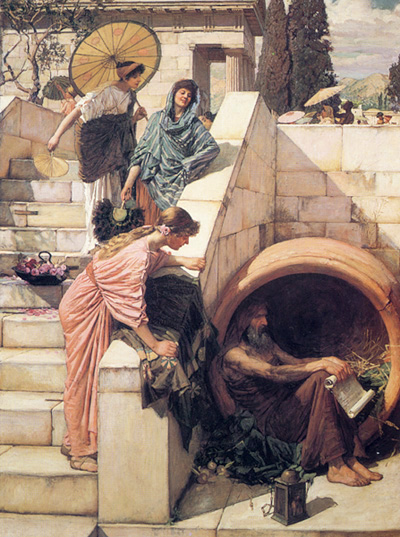
Alexander the Great was reported to have said, "Had I not been Alexander, I should have liked to be Diogenes." Once, while Diogenes was sunning himself, Alexander came up to him and offered to grant him any request. "Stand out of my light," he replied. When asked why he went about with a lamp in broad daylight, Diogenes confessed, "I am looking for a [honest] man."
Sunday, July 16, 2006
Raskolnikov and Nietzsche Have Compassion on a Beaten Animal
A few odds and ends from the day:
Exodus chp. 34 seems to have some bearing on a recent discussion at the Lonergan Institute on St. Augustine's discussion in De Trinitate of what the Scripture meant when it says that Moses saw God. It was this one I remembered without chapter and verse which seems to show an unbroken narrative of Moses seeing God and then his countenance being transformed by the experience. Although I would be loathe to disagree with Augustine on the doctrinal stance about seeing God I am do not find his exposition of this to ring true. However, in this passage the text does seem to emphasize Moses's hearing God rather than his seeing Him and it says God came down in a cloud. It says however that God stood by him and the effect is the resplendence of Moses countenance that is too bright for the Israelites to bear.
v.20 "No one shall appear before me empty handed." It occurs to me that there is a passage regarding King David in which he apparently shows abeyance to this verse in his pious appropriation of this statement from the Pentateuch.
**
I have been listening to selections from a wonderful cache of speeches at the Veritas Forum. Included among these are several speeches made by Dr. William Edgar which I have found quite good, in particular "A Biblical Theology of Entertainment" and "The Revenge of the Aesthetic".
An interesting point in the later is that apparently a number of infamous postmodern philosophers including Derrida have recently agreed in arguing against relativism when it came to beauty. As Edgar points out, Doestoevsky predicted that "Beauty will save the world." Is it possible that this is along the lines of what Doestoevsky meant? I will have to pull this fish in with this thread as much as I can in the coming days. I am convinced that Doestoevsky saw things that provided essential answers or guideposts to modern man past the impasse and quagmire of Nietzsche.
I also find it fascinating that the powerful dream remembrance of Raskolnikov in Crime and Punishment of his childhood compassion for a cruelly beaten donkey, in which he collapsed in tearful embrace of the dieing beast, juxtaposed with the murderer that he had become as an adult, resembles the collapse of Nietzsche, who's mystique of mercilessness was abrupted when he ran outside and tearfully embraced a horse that was being beaten by its master. It is from this point that Nietzsche's descent into madness is generally thought to have begun. Did this occur in Doestoevsky's lifetime, before the publishing of Crime and Punishment? I wonder if Doestoevsky knew of this? Or perhaps there is just an uncanny correspondence here. In any case, it is especially resonant to me because I believe that Doestoevsky powerfully conveyed the way to freedom past the "intellectual swindlers" of the day and specifically that he compassionately showed the way past Nietzsche's saccharine lies by a greater authenticity. Nietzsche himself said of Doestoevsky that he was the only psychologist that he had anything to learn from. Would that he had learned more!
Exodus chp. 34 seems to have some bearing on a recent discussion at the Lonergan Institute on St. Augustine's discussion in De Trinitate of what the Scripture meant when it says that Moses saw God. It was this one I remembered without chapter and verse which seems to show an unbroken narrative of Moses seeing God and then his countenance being transformed by the experience. Although I would be loathe to disagree with Augustine on the doctrinal stance about seeing God I am do not find his exposition of this to ring true. However, in this passage the text does seem to emphasize Moses's hearing God rather than his seeing Him and it says God came down in a cloud. It says however that God stood by him and the effect is the resplendence of Moses countenance that is too bright for the Israelites to bear.
v.20 "No one shall appear before me empty handed." It occurs to me that there is a passage regarding King David in which he apparently shows abeyance to this verse in his pious appropriation of this statement from the Pentateuch.
**
I have been listening to selections from a wonderful cache of speeches at the Veritas Forum. Included among these are several speeches made by Dr. William Edgar which I have found quite good, in particular "A Biblical Theology of Entertainment" and "The Revenge of the Aesthetic".
An interesting point in the later is that apparently a number of infamous postmodern philosophers including Derrida have recently agreed in arguing against relativism when it came to beauty. As Edgar points out, Doestoevsky predicted that "Beauty will save the world." Is it possible that this is along the lines of what Doestoevsky meant? I will have to pull this fish in with this thread as much as I can in the coming days. I am convinced that Doestoevsky saw things that provided essential answers or guideposts to modern man past the impasse and quagmire of Nietzsche.
I also find it fascinating that the powerful dream remembrance of Raskolnikov in Crime and Punishment of his childhood compassion for a cruelly beaten donkey, in which he collapsed in tearful embrace of the dieing beast, juxtaposed with the murderer that he had become as an adult, resembles the collapse of Nietzsche, who's mystique of mercilessness was abrupted when he ran outside and tearfully embraced a horse that was being beaten by its master. It is from this point that Nietzsche's descent into madness is generally thought to have begun. Did this occur in Doestoevsky's lifetime, before the publishing of Crime and Punishment? I wonder if Doestoevsky knew of this? Or perhaps there is just an uncanny correspondence here. In any case, it is especially resonant to me because I believe that Doestoevsky powerfully conveyed the way to freedom past the "intellectual swindlers" of the day and specifically that he compassionately showed the way past Nietzsche's saccharine lies by a greater authenticity. Nietzsche himself said of Doestoevsky that he was the only psychologist that he had anything to learn from. Would that he had learned more!
A Christian Theology of Romantic Love
Harry Blamires provides in The Christian Mind a list of a handful of books that break some ground in forming a much needed Christian theology of romantic love. I admit a fondness for such lists by someone such as Blamires. First Blamires discusses the sorry state of Christian thinking regarding sexuality:
"Whilst Christians have been aware of this pattern of demand and response in moral sphere and in the spiritual sphere, its relevance to such things as human sexuality, or experience of beauty in art and Nature, has been largely ignored. This is because we lack a Christian mind. The field of discourse upon these rich areas of human experience has been left to the secularists. Some of them have trodden there with clinical irreverence. Others, like the poets [he means the Romantic poets], with greater reverence but with too little understanding. Hence the moving, sensitive, but eventually frustrating raptures of a Shelley. Hence the grand gropings of Wordsworth, a melancholy monument to the ultimate dissatisfactions of Christian brinkmanship."
Blamires then provides the following list of books as the ones that he drew on in the chapter "Its Sacramental Cast":
He Came Down From Heaven and The Figure of Beatrice by Charles Williams.
The Meaning of Love by Vladimir Solovyev
The Unknown Eros and The Rod, the Root, and the Flower by Coventry Patmore
He writes in particular of Charles Williams, the most idiosyncratic member of the Inklings (C..S. Lewis and J.R.R. Tolkien being other members):
"Charles Williams tried to fill the gap. He left behind him a comprehensive, illuminating, and orthodox Romantic theology which does justice to the spiritual significance of sexual love. Christians who are aware of the need to reconstitute a Christian mind able to cope with all human experience theologically ought to consult his work, notably He Came down from Heaven and The Figure of Beatrice."
(See this Touchstine article "What About Charles Williams?" for more about him. Beatrice was the woman that Dante Alighieri fell in love in his youth and regarding whom he wrote La Vita Nuova. His experience of romantic infatuation with Beatrice and her early death had a decisive formative effect on Dante. )
Vladimir Solovyev is said to have put Russian philosophy on the map. His lectures were attended by Tolstoy and Doestoevsky and he became a friend of Doestoevsky. It is thought that Doestoevsky based both Alyosha and Ivan in The Brothers Karamazov on Solovyev. It appears no small praise that Hans Urs von Balthasar saw in Solovyev ""the greatest artist of [conceptual order] and organization'- after St. Thomas- in the entire history of thought, a thinker who borrows from all systems after purging them of their 'negations'. His philosophical and religious thought is 'a work of art' on a large scale- a drama, an epic, and a hymn to the universe" (George L. Kline). It is also said of Solovyev that he was the first contemporary thinker to devote himself to the reunification of the churches. George L. Kline calls him "perhaps the most impotant proponent of ecumencial principles in Europe after Leibniz." I have just acquired Solovyev's The Meaning of Love and Lectures on Divine Humanity and anticipate posting on them in the future.
"Whilst Christians have been aware of this pattern of demand and response in moral sphere and in the spiritual sphere, its relevance to such things as human sexuality, or experience of beauty in art and Nature, has been largely ignored. This is because we lack a Christian mind. The field of discourse upon these rich areas of human experience has been left to the secularists. Some of them have trodden there with clinical irreverence. Others, like the poets [he means the Romantic poets], with greater reverence but with too little understanding. Hence the moving, sensitive, but eventually frustrating raptures of a Shelley. Hence the grand gropings of Wordsworth, a melancholy monument to the ultimate dissatisfactions of Christian brinkmanship."
Blamires then provides the following list of books as the ones that he drew on in the chapter "Its Sacramental Cast":
He Came Down From Heaven and The Figure of Beatrice by Charles Williams.
The Meaning of Love by Vladimir Solovyev
The Unknown Eros and The Rod, the Root, and the Flower by Coventry Patmore
He writes in particular of Charles Williams, the most idiosyncratic member of the Inklings (C..S. Lewis and J.R.R. Tolkien being other members):
"Charles Williams tried to fill the gap. He left behind him a comprehensive, illuminating, and orthodox Romantic theology which does justice to the spiritual significance of sexual love. Christians who are aware of the need to reconstitute a Christian mind able to cope with all human experience theologically ought to consult his work, notably He Came down from Heaven and The Figure of Beatrice."
(See this Touchstine article "What About Charles Williams?" for more about him. Beatrice was the woman that Dante Alighieri fell in love in his youth and regarding whom he wrote La Vita Nuova. His experience of romantic infatuation with Beatrice and her early death had a decisive formative effect on Dante. )
Vladimir Solovyev is said to have put Russian philosophy on the map. His lectures were attended by Tolstoy and Doestoevsky and he became a friend of Doestoevsky. It is thought that Doestoevsky based both Alyosha and Ivan in The Brothers Karamazov on Solovyev. It appears no small praise that Hans Urs von Balthasar saw in Solovyev ""the greatest artist of [conceptual order] and organization'- after St. Thomas- in the entire history of thought, a thinker who borrows from all systems after purging them of their 'negations'. His philosophical and religious thought is 'a work of art' on a large scale- a drama, an epic, and a hymn to the universe" (George L. Kline). It is also said of Solovyev that he was the first contemporary thinker to devote himself to the reunification of the churches. George L. Kline calls him "perhaps the most impotant proponent of ecumencial principles in Europe after Leibniz." I have just acquired Solovyev's The Meaning of Love and Lectures on Divine Humanity and anticipate posting on them in the future.
Saturday, July 15, 2006
Philip Rieff: Deconstructing the Heart of Darkness
Recently I have been tantalized by some discussion of Philip Rieff's thought in First Things (see Richard John Neuhaus's discussion upon Rieff's death at 83 this last week) and The New Pantagruel (see "Life Words: A Review of My Life Among the Deathworks: Illustrations of the Aesthetics of Authority" ).
I was particularly interested in Neuhaus's following comment on Rieff:
I was particularly interested in Neuhaus's following comment on Rieff:
"People who try to practice orthodox Christianity and Judaism today, he says, inevitably remain trapped in the vocabulary of therapy and self-fulfillment. “I think the orthodox are role-playing,” he says. “You believe because you think it’s good for you, not because of anything inherent in the belief. I think that the orthodox are in the miserable situation of being orthodox for therapeutic reasons.” I’m still reading the last book, but I think Rieff is saying that it’s all over. I don’t think he’s right about that. I hope he’s not right about that. But he could be right about that. At the very least, it is a possibility to be considered when proposed by one so thoughtful as Philip Rieff. Christ never said of Western Civilization that the gates of hell shall not prevail against it."
This made me think. Rieff's comment is like Paul's exhortation to his audience to search themselves to see if they believe, or has a similar effect. Neuhaus sees the implication for Western culture as a whole. More immediately it makes me think of the implication for myself and the actual ways of thinking and if they actually spring from a heart set on Christ or are rationalized distances and putrid mockeries.
From the review article for his last book (which thankfully he delivered to us before he died), Rieff is quoted:
"Culture is the form of fighting before the firing actually begins.”
“I intend to describe that unprecedented condition of fighting against the cultural predicate that organized all human societies until almost our own time. That predicate I call sacred order.”
Jess Castle's review notes the following (to understand further what is meant by third culture I refer to the review or better yet to the book, which I am ordering):
"The third culture disposition has been introduced by cultural elites, mostly artists and writers. Accordingly, much of the book is devoted to deconstructions of their “deathworks.” Deathwork is Rieff’s term for “the resolution, in life and/or art, of a particular world creation.” More plainly put, deathworks are cultural creations that function as hidden assaults on true culture. In his analyses of third culture deathworks, Rieff seeks to expose the de-creation—the undoing of sacred order—that constitutes the central task of late modern literature and art. Rieff gives brief, dense readings of Duchamp, Picasso, Joyce, Kafka—and the list goes on. He writes, “I hope to take the reader behind and beyond contemporary reality by juxtaposing events and works that do not appear, on first reading, to be related. Call it deconstructing radical contemporaneity.” These readings are intended to allow the reader to see clearly through late modernity and enter sacred order, to which we have been blinded by so many images destructive of it. Rieff’s breakdowns of deathworks are deeply compelling, and their logic hard to dispute."
Here is another quote of Rieff in the review article that I found tantalizing:
For Rieff, then, the not-I/I of second culture identity possesses a strength that third world-dominated selves cannot attain—no surprise to anyone who has read his earlier works. Whatever one thinks of Rieff’s concept of the sacred self, his descriptions of it can be quite powerful. Consider the following passage on Gerard Manley Hopkins:
Whatever the shatterings Hopkins felt threatened his and other sacred selves, perhaps precisely because of that threat, he composed the greatest passage on the God-relation of identity since Galatians 2:20. Despair shatters itself against the hard truth of Hopkins’s sense of identity. Whatever the shatterings Hopkins felt threatened his and other sacred selves, perhaps precisely because of that threat, he composed the greatest passage on the God-relation of identity since Galatians 2:20. Despair shatters itself against the hard truth of Hopkins’s sense of identity.
I am all at once what Christ is, since he was what I am, andThis, Jack, joke, poor potsherd, patch, matchwood, immortal diamond, Is immortal diamond.Whatever the Jack, joke, mortal trash of our lives may be, our predicative relational identity, Not-I/I, supplies the resistant hardness of sacred self Hopkins blazons in everyone’s honor, each Not-I/I an “immortal diamond.” When I read Hopkins, as when I hear a Bach mass, I am an honorary Christian. The aesthetics of truth form alliances, profoundly elective affinities, that the intellect stripped of feeling inclines to reject…. Intellection must address the matter of its feeling.
Such evocative passages cast doubt on third culture’s assertion that “there are no truths, only rhetorics of power and self-interest.”
I am take out a particularly resonant line for me and repeat it here:
"Intellection must address the matter of its feeling."
He is well focused and I think could prove an insightful read. I look forward to the more in depth discussion of his work that will be coming out in the August/ September edition of First Things and to his last book.
Saturday, July 08, 2006
Some context for Blamire's The Christian Mind
Interesting to note Blamires's The Christian Mind in its larger context as noted in this article in The New Pantagruel:
Anti-Intellectualism: Parallel to the above concerns, many of these authors further object to an anti-intellectual mindset they perceive behind the popular evangelical distrust of theology. And this anti-intellectualism finds additional critique from the pen of evangelical historian Mark Noll in his 1994 Scandal of the Evangelical Mind.36 Describing his perspective as that of a “wounded lover,”37 Noll opens his volume with a powerful accusation, “The scandal of the evangelical mind is that there is not much of an evangelical mind.”38 While evangelicals have been strong on piety and evangelism, zealous in missions and mercy ministries and activism, they have neglected the serious life of the mind, a charge he repeatedly demonstrates by appeal to the continued lack of an evangelical research university fifty years into the movement’s modern incarnation. Indeed, evangelicals “have nourished millions of believers in the simple verities of the gospel but have largely abandoned the universities, the arts, and other realms of ‘high’ culture.”39
Also in 1994, Os Guinness accused evangelicals of anti-intellectualism in Fit Bodies, Fat Minds: Why Evangelicals Don’t Think and What to Do About It.40 Blaming the eight “P”s of polarization, pietism, primitivism, populism, pluralism, pragmatism, philistinism and premillenialism—alongside what he terms the “idiot culture” of postmodern America—Guiness calls on evangelicals to think critically about all of life from a biblically-defined perspective. Both Guiness’ and Noll’s critiques find precedent in Harry Blamires’ 1963 classic The Christian Mind, in which Blamires disparages the Christian mind for succumbing to the secular drift of western culture at large.41 Indeed, the evangelical movement’s modern incarnation began with a self-critique book accusing fundamentalism of anti-intellectualism and cultural obscurantism, Carl F. H. Henry’s 1947 book, The Uneasy Conscience of Modern Fundamentalism.42
But in all of these contemporary criticisms of American evangelicalism, personal ethics and morality are nowhere targeted. Nor are evangelicals in these volumes called to new moral or political crusades in the culture at large. No new activism is called for. Rather, the focus is on reforming the theology of the churches with a renewed vision of God’s greatness, holiness, grace and sovereign power. And behind this emphasis on the highness of God stands a concern for the ultimacy of biblical authority, an authority these authors see attacked on every front, not from the outside, but from within the evangelical movement itself.
Anti-Intellectualism: Parallel to the above concerns, many of these authors further object to an anti-intellectual mindset they perceive behind the popular evangelical distrust of theology. And this anti-intellectualism finds additional critique from the pen of evangelical historian Mark Noll in his 1994 Scandal of the Evangelical Mind.36 Describing his perspective as that of a “wounded lover,”37 Noll opens his volume with a powerful accusation, “The scandal of the evangelical mind is that there is not much of an evangelical mind.”38 While evangelicals have been strong on piety and evangelism, zealous in missions and mercy ministries and activism, they have neglected the serious life of the mind, a charge he repeatedly demonstrates by appeal to the continued lack of an evangelical research university fifty years into the movement’s modern incarnation. Indeed, evangelicals “have nourished millions of believers in the simple verities of the gospel but have largely abandoned the universities, the arts, and other realms of ‘high’ culture.”39
Also in 1994, Os Guinness accused evangelicals of anti-intellectualism in Fit Bodies, Fat Minds: Why Evangelicals Don’t Think and What to Do About It.40 Blaming the eight “P”s of polarization, pietism, primitivism, populism, pluralism, pragmatism, philistinism and premillenialism—alongside what he terms the “idiot culture” of postmodern America—Guiness calls on evangelicals to think critically about all of life from a biblically-defined perspective. Both Guiness’ and Noll’s critiques find precedent in Harry Blamires’ 1963 classic The Christian Mind, in which Blamires disparages the Christian mind for succumbing to the secular drift of western culture at large.41 Indeed, the evangelical movement’s modern incarnation began with a self-critique book accusing fundamentalism of anti-intellectualism and cultural obscurantism, Carl F. H. Henry’s 1947 book, The Uneasy Conscience of Modern Fundamentalism.42
But in all of these contemporary criticisms of American evangelicalism, personal ethics and morality are nowhere targeted. Nor are evangelicals in these volumes called to new moral or political crusades in the culture at large. No new activism is called for. Rather, the focus is on reforming the theology of the churches with a renewed vision of God’s greatness, holiness, grace and sovereign power. And behind this emphasis on the highness of God stands a concern for the ultimacy of biblical authority, an authority these authors see attacked on every front, not from the outside, but from within the evangelical movement itself.
Blamires, New Urbanism, and Thinking Christianly about Technology
I found Blamires book (see earlier post on his book) very stimulating, a withering critique with strength, freshness and perceptiveness, so I plan to blog some of his thoughts here. In chapter 5, "Its Concern For the Person" of The Christian Mind Blamires deals with the challenge to the Christian mind to think Christianly about the technology in the modern world. I found it refreshing that he presented such cogent thoughts paralleling the current movements such as New Urbanism back in 1963.
He identifies servitude to the machine as a mark of contemporary worldliness and a challenge to the Christian mind. He identifies two aspects of this servility, the practical and the theoretical.
"The theoretical aspect is the fact that modern man is increasingly living his day-to-day life in servitude to mechanical contrivances. The theoretical aspect is the fact that the machine has now produced a way of thinking as well as a way of living."
Blamires notes that this way of thinking extends beyond spheres of life to which mechanical things are relevant. It is interesting note here a parallel understanding, or view if you prefer, expressed by Blamires' tutor C.S. Lewis (who encouraged Blamires to write) in "Is History Bunk?", a look at what appears to me to to be same servility of mind applied to the subject of history, but then touching upon technology as well with the mention of Henry Ford:
"There will always be those who, on discovering that history cannot really be turned to much practical account, will pronounce history to be Bunk. Aristotle would have called this servile or banausic; we, more civilly, may christen it Fordism."
Is servile a good term to characterize much of our thought about modern technology? Is the posthumanism movement in a sense a total surrender to the view humanity as technology and therefore properly adjustable in terms of the technology supplementing the technology that is humanity? The late Neil Postman in such books as Technopoly and Amusing Ourselves to Death stressed the danger of the complacency of the modern mind in dealing with its technology and the need to critically think about the place we as a society should designate for technology. Another contemporary thinker of choice value on in stimulating thought and consideration on this matter is the maveric siomething of a prophet Wendell Berry in his many essays on our relation to technology and the environment. (He detests the word environment for the kind of relationship to the nature implicit in the word). But to return to Blamires (shortly, in the next posts).
He identifies servitude to the machine as a mark of contemporary worldliness and a challenge to the Christian mind. He identifies two aspects of this servility, the practical and the theoretical.
"The theoretical aspect is the fact that modern man is increasingly living his day-to-day life in servitude to mechanical contrivances. The theoretical aspect is the fact that the machine has now produced a way of thinking as well as a way of living."
Blamires notes that this way of thinking extends beyond spheres of life to which mechanical things are relevant. It is interesting note here a parallel understanding, or view if you prefer, expressed by Blamires' tutor C.S. Lewis (who encouraged Blamires to write) in "Is History Bunk?", a look at what appears to me to to be same servility of mind applied to the subject of history, but then touching upon technology as well with the mention of Henry Ford:
"There will always be those who, on discovering that history cannot really be turned to much practical account, will pronounce history to be Bunk. Aristotle would have called this servile or banausic; we, more civilly, may christen it Fordism."
Is servile a good term to characterize much of our thought about modern technology? Is the posthumanism movement in a sense a total surrender to the view humanity as technology and therefore properly adjustable in terms of the technology supplementing the technology that is humanity? The late Neil Postman in such books as Technopoly and Amusing Ourselves to Death stressed the danger of the complacency of the modern mind in dealing with its technology and the need to critically think about the place we as a society should designate for technology. Another contemporary thinker of choice value on in stimulating thought and consideration on this matter is the maveric siomething of a prophet Wendell Berry in his many essays on our relation to technology and the environment. (He detests the word environment for the kind of relationship to the nature implicit in the word). But to return to Blamires (shortly, in the next posts).
Thursday, July 06, 2006
Theistic Science
Materialism is a matter of faith, science is not- not in the sense of merely being investigation of material causes. I recognize material causes like materialsts do but this is not a belief that originated with materialism but already within the theist worldview, from which science sprang. The theist worldview recognizes material causality and also has a clarified and reasonable standpoint from which to view it. There is no necessity to be a materialist in order to do and recognize science nevertheless one finds an ubiquitous conflation of clearminded material investigation with, in my view, imbalanced materialism that incautiously forgoes altogether the kind of self-examination Socrates memorably urged, disparaging the obvious knowledge attainable in it through disciplined and noble as altogether nothing but "navel-gazing". Christian theism understands and embraces what is good in both material investigation and self-knowledge (and knowledge of other minds) instead of charging with the bandwagon into "the wasteland". Many valuably see great unifying potential, and some more keenly than others, in science and material investigation. I see this unifying power essentially unassailed in a clarifying theism, which provides a "maximum of differentiation" that materialism fails to attain.
An individual recently wrote to me saying, "The fact that 'mind' cannot be demonstrated leads us to the possibly incomplete explanations defined by science and its inability to deal with your concept 'mind'. " I think this point is over the beating heart of the modern problem. In fact we cannot explain anything except from a starting point that takes the mind's existence for granted. In every act of explanation or rationalization the mind is already there. The mischaracterization of knowledge and learning shared by both Kant and Hume which minimalizes knowledge by not dealing with the presence of the mind already implicit in every moment of perception seems to be the web we are caught on.
Science hit a brick wall with the Big Bang. But the framing of the question seems key to me. Science has worked off the assumption of the mind. It has to to act. Nietzsche laments this when he writes:
"[Unbelieving philosophers of late modernity] are far from being free spirits for they still have a faith in truth... It is still a metaphysical faith that underlies our faith in science- and we men of knowledge today, we godless men and anti-metaphysicians, we, too, still derive our flame from the fire ignited by faith a millenia old, the Christian faith, which was also Plato's, that God is truth, that truth is divine."-in "Genealogy of Morals."
How is a cultivated ignorance of the starting point we take for granted, by an axiomatical denial of knowledge outside the sequential Method artificially imposed, in the end, promising of knowledge of ourselves superior for instance to that reached by the Greeks, or to the great geniuses of the world of all the different nations? The supposition that those who study neurobiology are likely to attain greater self-knowledge than those who read the classics that many of them look down on from a supposedly epistemologically sacrosanct perspective, appears, with a little reflection, preposterous. In fact materialism makes natural sciences into an impostor and despoiler of human self-knowledge by setting up an unholy caste system of concocted epistemology, but a clarified theism avoids this by understanding material investigation and also the inviolate mind.
An individual recently wrote to me saying, "The fact that 'mind' cannot be demonstrated leads us to the possibly incomplete explanations defined by science and its inability to deal with your concept 'mind'. " I think this point is over the beating heart of the modern problem. In fact we cannot explain anything except from a starting point that takes the mind's existence for granted. In every act of explanation or rationalization the mind is already there. The mischaracterization of knowledge and learning shared by both Kant and Hume which minimalizes knowledge by not dealing with the presence of the mind already implicit in every moment of perception seems to be the web we are caught on.
Science hit a brick wall with the Big Bang. But the framing of the question seems key to me. Science has worked off the assumption of the mind. It has to to act. Nietzsche laments this when he writes:
"[Unbelieving philosophers of late modernity] are far from being free spirits for they still have a faith in truth... It is still a metaphysical faith that underlies our faith in science- and we men of knowledge today, we godless men and anti-metaphysicians, we, too, still derive our flame from the fire ignited by faith a millenia old, the Christian faith, which was also Plato's, that God is truth, that truth is divine."-in "Genealogy of Morals."
How is a cultivated ignorance of the starting point we take for granted, by an axiomatical denial of knowledge outside the sequential Method artificially imposed, in the end, promising of knowledge of ourselves superior for instance to that reached by the Greeks, or to the great geniuses of the world of all the different nations? The supposition that those who study neurobiology are likely to attain greater self-knowledge than those who read the classics that many of them look down on from a supposedly epistemologically sacrosanct perspective, appears, with a little reflection, preposterous. In fact materialism makes natural sciences into an impostor and despoiler of human self-knowledge by setting up an unholy caste system of concocted epistemology, but a clarified theism avoids this by understanding material investigation and also the inviolate mind.
Monday, July 03, 2006
Pascal and Blamires
From Pascal's Pensees:
"2 Order by dialogues. "What must I do? I see nothing but obscurities on every side.'
'Shall I believe I am nothing? Shall I believe I am God?'"
****
I am drawing to the end of Harry Blamires book The Christian Mind and have come across a section of remarkable prescience when he applies the Christian considerations to our use of technologies. It is very congenial to some of the concerns of New Urbanism and environmentalism but from a robustly Christian perspective.
"2 Order by dialogues. "What must I do? I see nothing but obscurities on every side.'
'Shall I believe I am nothing? Shall I believe I am God?'"
****
I am drawing to the end of Harry Blamires book The Christian Mind and have come across a section of remarkable prescience when he applies the Christian considerations to our use of technologies. It is very congenial to some of the concerns of New Urbanism and environmentalism but from a robustly Christian perspective.
Subscribe to:
Posts (Atom)